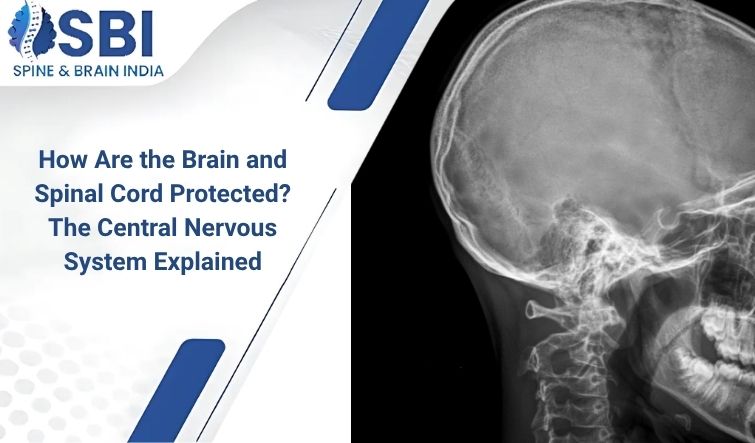
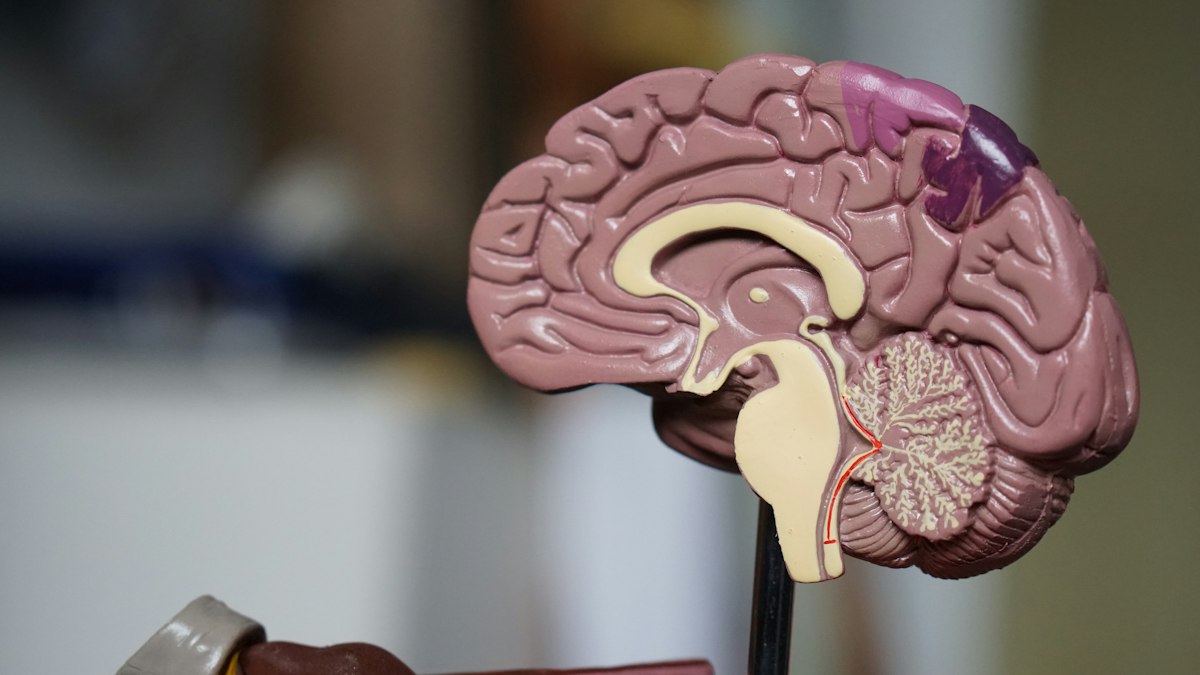
The brain and spinal cord together form the central nervous system (CNS) — the master control system of your entire body, coordinating every thought, movement, sensation, and automatic function. Because the CNS is so critical to life, the human body has evolved remarkable protective structures for it. In this expert guide, د. آرون ساروها explains exactly how the brain and spinal cord are protected, what can go wrong, and the practical steps you can take to protect your CNS health.
Part 1: How Is the Brain Protected?
The brain has four layers of protection working together. Our comprehensive article on how the brain is protected by the skull, meninges, CSF, and blood-brain barrier explains each layer in detail. In summary:
- Skull (Cranium): The outermost rigid bony enclosure of 22 fused bones that distributes and absorbs impact forces.
- Meninges (3 layers): Dura mater, arachnoid mater, and pia mater — three connective tissue membranes wrapping the brain.
- Cerebrospinal Fluid (CSF): A liquid cushion that reduces brain weight, absorbs shock, removes waste, and delivers nutrients.
- Blood-Brain Barrier (BBB): A selective molecular membrane that blocks toxins, pathogens, and harmful substances from entering brain tissue.
Part 2: How Is the Spinal Cord Protected?
The spinal cord — a delicate column of nerve tissue running from the brainstem to the lower back — is equally well-protected but through a different structural system. How the brain and spinal cord are protected shares the meningeal and CSF protection but differs significantly in the bony enclosure:
The Vertebral Column: The Spinal Cord’s Articulated Bony Canal
ال vertebral column consists of 33 vertebrae — 7 cervical (neck), 12 thoracic (chest), 5 lumbar (lower back), 5 sacral (fused), and 4 coccygeal (fused). These stack vertically and form the spinal canal — a hollow bony tunnel through which the spinal cord runs. Unlike the skull’s rigid fixed protection, the vertebral column provides protection while allowing the flexibility needed for movement.
The brainstem — the portion of the brain that transitions into the spinal cord — is the critical relay junction. This is the region responsible for controlling automatic breathing and also for تنظيم ضغط الدم — making the protection of this brain-spinal cord junction absolutely critical to life.
Intervertebral Discs: The Spinal Shock Absorbers
Intervertebral discs — fibrocartilaginous cushions between adjacent vertebrae — absorb compressive forces during movement and prevent bone-to-bone contact. Each disc has a tough outer ring (annulus fibrosus) and a gel-like centre (nucleus pulposus). When discs degenerate or herniate, they press on the spinal cord or nerve roots — causing pain, numbness, and neurological deficits. This is one of the most common conditions treated at Spine and Brain India.
Spinal Ligaments and Back Muscles: The Dynamic Stabilizers
The vertebral column is further stabilized by a complex system of ligaments (anterior longitudinal ligament, posterior longitudinal ligament, ligamentum flavum) and surrounding back and core muscles. These dynamic stabilizers prevent excessive movement that could injure the spinal cord and add a functional layer of protection beyond the passive bony structure.
Shared Protection: Meninges and CSF in Both Brain and Spinal Cord
The same three-layer meningeal system that protects the brain continues downward to wrap the entire spinal cord:
- Spinal Dura Mater: Forms a tough tubular sheath around the spinal cord within the spinal canal. Space between the dura and vertebral canal walls (epidural space) contains fat and blood vessels.
- Spinal Arachnoid Mater: The middle layer creating the spinal subarachnoid space filled with CSF. Spinal taps (lumbar puncture) sample this CSF for diagnostic purposes.
- Spinal Pia Mater: Directly adheres to the spinal cord surface, carrying blood vessels that supply the cord.
CSF circulates continuously from the brain’s ventricles down through the spinal subarachnoid space and back up — providing buoyancy, shock absorption, waste removal, and pressure regulation for the entire CNS. This unified circulation is why conditions like meningitis affect both the brain and spinal cord simultaneously, and why early treatment is so critical.
Common Threats to CNS Protection — and Their Warning Signs
Despite these remarkable protective systems, the CNS remains vulnerable to:
- Traumatic Brain Injury (TBI): India’s leading cause is road accidents — especially two-wheeler riders without helmets.
- Brain Hemorrhage: Uncontrolled hypertension is the #1 cause. Knowing أعراض نزيف الدماغ — sudden thunderclap headache, one-sided weakness, confusion, vision changes — can be lifesaving.
- Spinal Cord Injury (SCI): Vertebral fractures or dislocations damage or sever the cord, causing paralysis. High cervical injuries (C1–C4) stop breathing.
- Disc Herniation: Ruptured discs press on the spinal cord or nerve roots, causing radiating pain (sciatica), numbness, and weakness.
- Meningitis/Encephalitis: Infections breaching the meningeal protection cause life-threatening neurological emergencies.
- Tumors: Brain or spinal tumors compress CNS structures and progressively impair function.
How to Protect Your CNS: Evidence-Based Strategies for Indians
- Always wear a helmet and seatbelt — road accidents are India’s #1 cause of TBI and SCI.
- Control blood pressure rigorously — hypertension is the most important modifiable risk factor for brain hemorrhage and stroke. Understand how the brain controls blood pressure and why it must be protected.
- Maintain excellent posture — chronic poor posture accelerates disc degeneration and risks spinal cord compression over time.
- Strengthen core muscles — a strong core reduces spinal load and protects against disc herniation.
- Stay physically active — 150+ minutes of weekly exercise improves cerebral blood flow and spinal health simultaneously.
- Support children’s brain development — implement the science-backed strategies in our guide on how to increase brain power in children for optimal CNS development.
- Never ignore neurological symptoms — persistent back/neck pain, radiating limb pain, numbness, or weakness require prompt specialist evaluation.
الأسئلة المتكررة (FAQs)
Q1. How are the brain and spinal cord protected?
The brain is protected by the skull, three meningeal layers, cerebrospinal fluid, and the blood-brain barrier. The spinal cord is protected by the vertebral column’s bony canal (33 vertebrae), the same three meningeal layers, intervertebral discs (shock absorption), cerebrospinal fluid, and surrounding spinal ligaments and muscles.
Q2. What is the function of the meninges in CNS protection?
The three meningeal layers (dura, arachnoid, pia mater) provide physical protection for both the brain and spinal cord, contain and circulate CSF, supply blood vessels to CNS tissue, and create anatomical compartments that limit the spread of infection and hemorrhage.
Q3. How many vertebrae protect the spinal cord?
The vertebral column has 33 vertebrae: 7 cervical, 12 thoracic, 5 lumbar, 5 sacral (fused into the sacrum), and 4 coccygeal (fused into the coccyx). Together they form the spinal canal — a bony tunnel that protects the spinal cord along its entire length.
Q4. What happens if the spinal cord is injured?
Spinal cord injury causes loss of motor function, sensation, and autonomic control below the injury level. Cervical injuries can cause tetraplegia (all four limbs) and may stop breathing. Lumbar injuries cause paraplegia (lower body). Immediate neurosurgical care is critical to prevent further secondary injury.
Q5. Is the brain or spinal cord more vulnerable to injury?
Both are highly vulnerable but in different ways. The brain is more protected by the rigid skull but faces higher risk from vascular events (stroke, hemorrhage) and intracranial pressure changes. The spinal cord faces greater risk from flexion-extension trauma because the flexible vertebral column allows injury-producing movements that the rigid skull prevents for the brain.
Q6. When should I see a spine and brain specialist?
Consult a specialist for: persistent back or neck pain not resolving with rest, radiating pain to arms or legs, numbness or weakness in limbs, bladder/bowel dysfunction, balance problems, or any sudden neurological symptoms. Early intervention prevents permanent neurological damage.
Conclusion: The CNS Is Remarkably Protected — But Needs Your Active Care
فهم how the brain and spinal cord are protected — through the skull, vertebral column, meninges, intervertebral discs, cerebrospinal fluid, and blood-brain barrier — reveals the extraordinary engineering of the human central nervous system. These structures work together seamlessly to protect your most vital organs. But they have limits — and the lifestyle choices you make every day either support or undermine these protective systems.
EXPERT NEUROSURGERY & SPINE CONSULTATION — INDIA
🧠 Back Pain, Neck Pain or Neurological Symptoms?
آمر د. آرون ساروها — India’s Leading Neurosurgeon & Spine Specialist with 20+ years of expertise in brain and spinal cord conditions. Advanced diagnosis and minimally invasive treatment.
✆ احجز استشارتك اليوم →✅ Available for In-Person & Online Consultations | Pan India